Cozy fantasy vs cozy mystery: how to tell them apart
Ask what the plot is for. If it is a case to solve, usually a murder, the book is a cozy mystery, even with witches and talking cats in it. If it is a life to build, like a shop, a home or a circle of friends, the book is cozy fantasy. Magic does not decide the genre. The question the book keeps asking does.
What is the one-question test?
Look at what the story needs to finish. Is the last chapter a culprit named, or a life settled?
In a cozy mystery, the crime comes first and everything else hangs on it. The shop, the town and the quirky neighbors are all there to give the sleuth somewhere to stand. The story ends when the case closes.
In cozy fantasy, the everyday life of the world is the subject. Running a shop, making a home and finding friends are the plot, not the backdrop. The stakes stay low and the tone stays warm. There is usually no world-ending threat and little graphic violence.
Here is the test in table form.
| Cozy fantasy | Cozy mystery | |
|---|---|---|
| What drives the plot | Building a life | Solving a crime |
| What counts as an ending | The shop is open, the home is settled | The culprit is named |
| Role of magic | Part of daily life | Can be present, but the case still leads |
| Typical trouble | A mishap, a move, a lonely season | A crime, usually a murder |
Take a famous example. In Legends & Lattes by Travis Baldree, an orc mercenary retires and opens a coffee shop. The shop is the plot, not a case. That is the shape of cozy fantasy, and the book is widely credited with bringing the label into wide use. If you want the longer definition, we wrote one: what is cozy fantasy.
Why do witchy cozy mysteries end up on fantasy shelves?
Because the covers and the furniture match. A witch, a coffee shop, a cat. Those are the same props cozy fantasy uses, so stores and readers often file the two together.
The props are not the genre, though. A cozy mystery can have a witch for a sleuth, a familiar for a sidekick and a spell or two. If a body turns up in chapter two and the rest of the book is about who did it, the case is still the plot. Cozy mystery centers on solving a crime even when it has magic in it. That makes it a different genre from cozy fantasy.
None of this makes one better. They are two different promises. If you pick up a book expecting a quiet year in a tea shop and get an investigation, you will feel misled. The reverse is just as true.
Which shelf books sit near the line?
A few shelf books show the test at work, and one is worth testing yourself.
For a clear life to build, start with The Coffee House Witch & The Grumpy Cat by Ariana Jade and Arizona Tape. It is tagged starting over and running a cozy shop, which is the life-to-build side of the test. Pumpkin Spice And All Things Nice by Laura Greenwood has a witch-run coffee shop too, and its trouble is tagged as magical mishaps, not a crime. For more of this kind, see the running a cozy shop page.
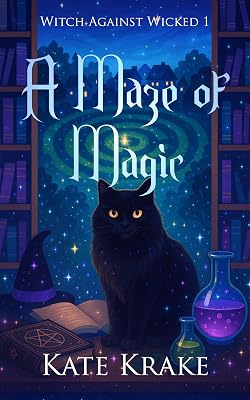
For one to test yourself, try A Maze of Magic by Kate Krake. Its blurb mentions a mystery. It is also tagged starting over and running a cozy shop, with romance in the background. I’d read the blurb and ask the question. Is the mystery the plot, or is one thread in a life being rebuilt? It is a good book to sit right on the line.
A puzzle is not the same as a case. The Road to Farringale by Charlotte E. English is about magick draining out of a country. That is a question about the world, not a crime to solve. It is more of an expedition than a whodunit.
What if you want no case at all?
Then look for books built around a setting and the people in it, not a crime. Two on the shelf are also tagged no romance.
Tales from a Magical Teashop by Casey Blair is a short story collection with nothing much at stake. It is easy to read in small pieces.
The Light That Remains by Richard Parry is tagged starting over and animal companions. I’d start there if you want no romance and a dog and a cat in the mix. If animals are what you want most, the animal companions page collects them.
How is cozy fantasy different from its other neighbors?
Cozy mystery is not the only genre that borrows the look. Two more get mixed up with it.
Paranormal romance centers on the couple, with the fantasy as setting. In cozy fantasy the world and its daily life are the subject, and romance ranges from none to central. Romantasy makes the romance a main plot, and many romantasy books have high stakes and are not cozy.
Tone can mislead too. A Wizard’s Guide to Defensive Baking by T. Kingfisher is warm in tone, but its stakes are higher than most cozy fantasy. A warm voice is not enough on its own. Ask what is at risk and what the book is for.
Romance level is its own filter on the shelf. A book can be cozy fantasy with romance central, or with none. What matters is that the world and its daily life stay at the center.
Can a book be both?
Sometimes. A book can have a small puzzle inside a larger story about settling in. The test still works. Ask which one the book would lose last. If you could remove the puzzle and still have the story, it is cozy fantasy with a mystery thread. If you could remove the shop and still have the story, it is a cozy mystery with a shop.
A few quick signs help before you read.
- A crime in the blurb, especially a death, points to mystery.
- Words like inherits, opens, starts over or moves home point to life-building.
- A blurb that stays on the setting, the food and the people points to cozy fantasy.
- A blurb that names a suspect, a victim or a detective points to mystery.
When the signs disagree, trust the first question. What is the plot for?
Browse the full shelf, or join the email list to get new free cozy fantasy books as they appear.